


Aardvark
Face to Face with an Aardvark
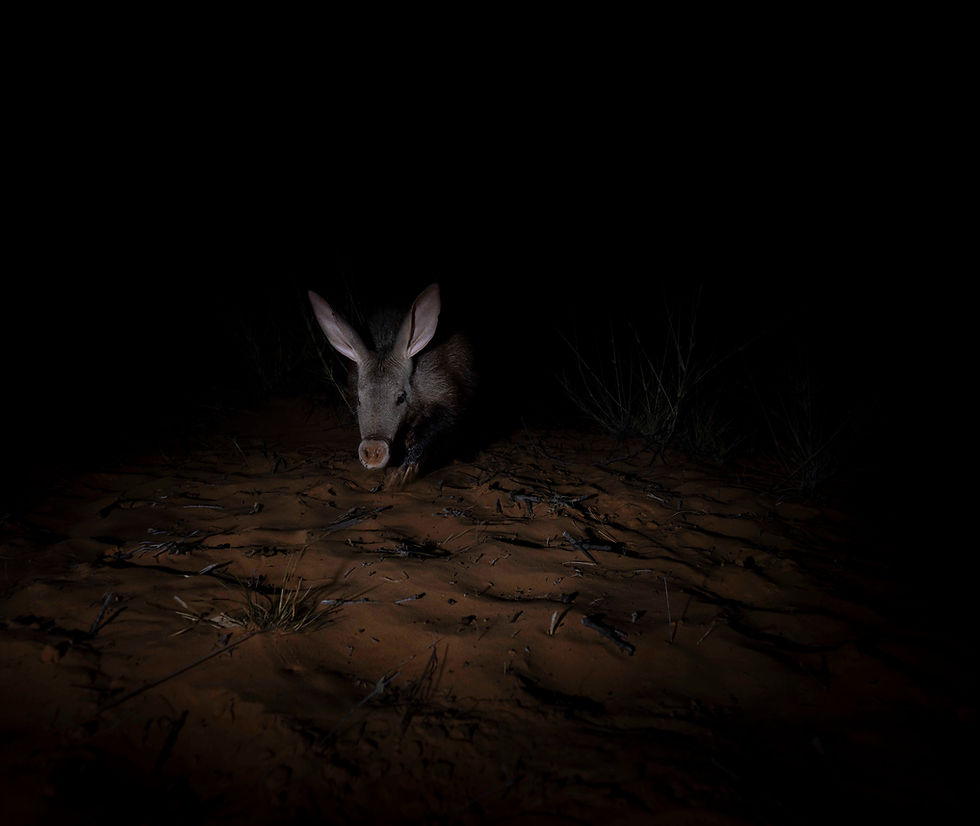
An encounter with one of Africa’s most elusive and unusual mammals.
There are wildlife encounters that are dramatic — a lion on a hunt, elephants charging through dust, a leopard appearing from the darkness.
And then there are encounters that are quieter, more unexpected, and somehow stay with you just as strongly.
My encounter with an aardvark was one of those moments.
During a visit to a wildlife rehabilitation centre, I was given the opportunity to spend time with an aardvark in their care. For a wildlife photographer, this was a rare privilege. Aardvarks are notoriously elusive, largely nocturnal and seldom encountered during conventional game drives. To have the opportunity to observe one at close range was something I wasn’t going to take for granted.
An Animal Unlike Any Other
Standing in front of an aardvark for the first time, it is difficult not to stare.
There is something almost prehistoric about them. The long, tubular snout, enormous ears, powerful forelimbs and thick body make the aardvark look as though it belongs to another era.
Yet every part of its appearance has a purpose.
The aardvark is exceptionally well adapted to life after dark. Its large ears are highly sensitive, helping it detect sounds while moving through the darkness. Its powerful claws allow it to excavate termite and ant nests, while its long, sticky tongue is perfectly suited to extracting insects from deep within their colonies.
It is a remarkable example of specialised evolution — an animal that may look unusual to us, but is incredibly well designed for the world it inhabits.
A Rare Photographic Opportunity
As a photographer, I was particularly interested in how I could capture an animal that is normally so difficult to see.
Photographing wildlife at night presents an entirely different set of challenges. There is very little available light, the subject can disappear into the darkness almost instantly, and there is very little room for error.
But this encounter was different.
Being able to spend time with the aardvark allowed me to slow down and observe rather than simply react to a fleeting sighting. I could watch the way it moved, the way it investigated its surroundings and the way its enormous ears constantly seemed to be listening to the world around it.
At times, it came remarkably close.
That created some unusual photographic opportunities — images that would be incredibly difficult to produce during a normal encounter in the wild.
One of my favourite photographs from the experience shows the aardvark emerging from almost complete darkness. Only the animal and the ground immediately around it are illuminated, while the rest of the frame disappears into black.
I wanted to keep the image dark.
Rather than trying to reveal every detail, I felt that allowing the darkness to dominate the photograph better represented the animal itself. The aardvark is a creature of the night, and the darkness is an important part of its story.
More Than Just an Unusual Face
It is easy to look at an aardvark and simply think of it as one of Africa’s strangest-looking mammals.
But there is much more to them than their appearance.
Aardvarks play an important role in their ecosystems. Their digging creates burrows that can later provide shelter for a variety of other animals. What begins as a refuge excavated by an aardvark can become an important shelter from heat, cold and predators for other species.
This is one of the things I find most fascinating about wildlife.
An animal doesn’t have to be large, powerful or visually spectacular to have an important role in its environment.
Sometimes the species that receive the least attention are quietly shaping the ecosystem around them.
Seeing the Individual
Spending time with an animal in a rehabilitation environment also changes the way you approach photography.
When photographing wild animals from a vehicle, there is often a degree of distance between photographer and subject. You may have only a few seconds to react before the animal disappears into the bush.
Here, I had the opportunity to observe the aardvark for longer.
And that meant I wasn’t just photographing an aardvark.
I was photographing an individual animal.
Its movements, curiosity and behaviour began to become more important than simply getting a technically perfect photograph.
That distinction matters to me.
Wildlife photography is often about chasing the perfect frame — the perfect light, the perfect composition, the perfect behaviour. But encounters like this remind me that photography is ultimately secondary to the experience itself.
The photograph is what we take home.
The encounter is what stays with us.
A Different Kind of Wildlife Experience
Perhaps what made this experience so memorable was how different it was from the wildlife encounters I am more accustomed to.
There was no dramatic chase. No roar. No herd moving through the landscape.
Instead, there was an unusual animal moving quietly through the darkness, doing what aardvarks have been doing for thousands of years.
And for a short period, I was fortunate enough to be there to watch.
For a wildlife photographer, opportunities like this are incredibly special. They allow us to photograph species that are rarely seen and, more importantly, to develop a deeper appreciation for animals that can easily be overlooked.
The aardvark may never receive the same attention as Africa’s lions, elephants or leopards.
But perhaps that is part of its appeal.
It doesn’t need to announce its presence.
It simply emerges from the darkness, goes about its life, and disappears again.
And sometimes, if you’re fortunate, it lets you see it.


